
Por Ison Dowdy. The Mexican Headline
A peer-reviewed study identifies government policies as the primary culprit. Public opinion pointed elsewhere.
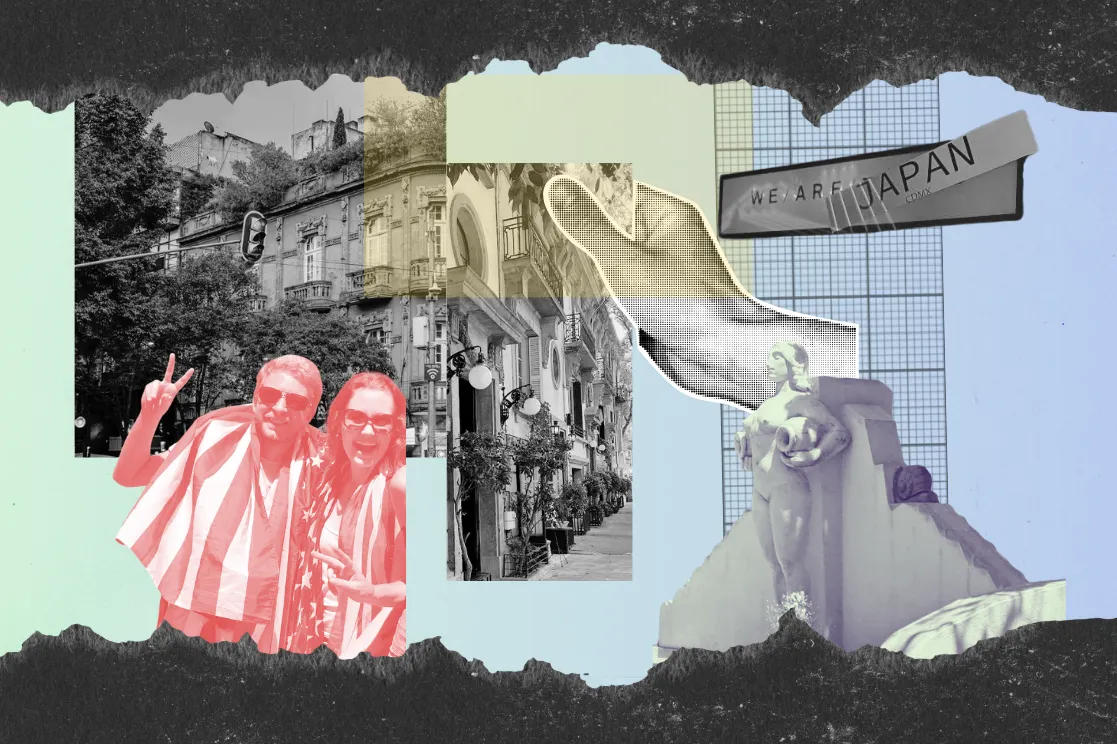
Jun 19, 2026, In May, Club Japan, a nightclub in Mexico City’s tourist-packed Roma Norte neighborhood, went viral after announcing on Instagram that it would begin charging Americans a whopping $5,000 pesos (about $300 USD) to enter its bass-thumping establishment. Everyone else — all other foreigners, Mexicans, Latin Americans, students, and teachers — get in for between $8 and $20 USD. The post got tens of thousands of likes, attracted international media coverage, and sparked a global conversation about gentrification in Mexico City… centered around Americans.
Not about the 20,000 Mexican families displaced every single year. Not about the politicians signing deals to accelerate that displacement. Not about the landlords consciously raising rent. Not about homes being turned into short term rentals on Airbnb.
Americans.
Many from the States, myself included, may be surprised to learn this, but there is a general consensus held by much of the world that we center ourselves too often. But here we are again; a nightclub in a hyper-gentrified Mexican neighborhood sparked a real conversation, but fully centered the US. There’s a word for that. Several, actually. But let’s start with the one that matters most: distraction.
Stay with me.
What Is Actually Happening in Mexico City
Before anything else, let’s be crystal clear about something: Mexican families are being displaced at an alarming rate and it’s only getting worse.
A peer-reviewed study published in the Proceedings of the National Academy of Sciences analyzed 16,000 property prices in Mexico City over the past two decades. The findings are not subtle.
The Numbers – PNAS Study, 2024
- 4x decrease in housing accessibility between 2005 and 2015
- 8x price increase in super-gentrified Polanco (2000–2018)
- 20,000 families displaced every single year
- 83,000 residents left Mexico City for the State of Mexico (2015–2020)
Additionally, a 94% rent increase attributed to gentrification.
These are not just abstract numbers. They’re families. They’re corner stores, street vendors, and community identities built over generations.
Mexican urbanist painter and graphic designer Gueko, whose art has been featured in exhibitions all over the city, expands on this point. “It’s not just living spaces,” he explained to me, his pop culture-inspired artwork surrounding us from the walls of his apartment. “ It’s recreational spaces too. Places to relax aren’t even accessible to me. It’s a constant stress.”
The anger that produced the 2025 July 4 protests, the “Go home gringo” graffiti on Roma Norte walls, and the thousands of comments in support of Club Japan’s new policy are not irrational and cannot be ignored. They’re a response to a real, well-documented, worsening crisis, and it deserves the full force of public pressure.
Which is exactly why it matters who that pressure is aimed at.
The Blame Game
The PNAS also examined causes. The conclusion is direct: displacement and gentrification in Mexico City predominantly originate from government policies, not from foreigners. They report:
“It is worth mentioning that the influx of digital nomads, which significantly increased during the COVID-19 pandemic, does not appear to significantly impact the dynamics of housing access … Based on our analysis, we infer that displacement and gentrification predominantly originate from government policies and politics.”
If you’re reading this as an American, no, you’re not totally off the hook. But I’ll get to you later.
So if not foreigners, then who?
1. The Government
Attracting foreign tourism and wealthy migrants has been a deliberate, decades-long economic strategy of the Mexican federal government. One of the most documented decisions came in 2022, when then-Mayor Claudia Sheinbaum, now President of Mexico, signed an agreement with Airbnb and UNESCO to position Mexico City as a digital nomad destination, despite existing concern about the impact short-term rentals were already having on housing. The administration publicly denied Airbnb was causing the displacement. Attracting foreigners has been a huge part of the economic strategy for years. And it worked.
What didn’t work was protecting the people already here. A 2021 joint study by UNAM’s Institute of Social Research and Habitat International Coalition found that 97% of evictions were carried out by landlord order rather than judicial process, and that a quarter of them involved violence.
“I had to tell my landlord what was in the law,” continued Gueko. “Like, he didn’t know that he couldn’t raise my rent, by law… He did it anyway. And he told me if you’re not in agreement, well then, get out.”
The authors of the study concluded that “until now there is no specific legislation on rental housing at the national or local level,” a gap that took until 2024 to begin addressing.
2. Landlords
Grassroots activists have named wealthy Mexicans as among the most aggressive gentrifiers, buying and building properties to list on Airbnb, and opening high-end businesses that serve an aspirational consumer rather than the community. A local landlord makes the decision and gets away with it.
“If tomorrow my landlord decided that he wanted to turn [my apartment] into an Airbnb or triple the rent just to get rid of me, he could do it,” Gueko sat up in his chair and rolled his eyes. “He can do whatever he wants. And it’s not regulated at all.”
3. Wealthy Mexicans
Gentrification in Mexico City did not begin with American digital nomads. It began with wealthier Mexicans. Polanco and Condesa were already undergoing internal class transformation in the 1990s, decades before the pandemic nomad wave. A Mexico City resident wrote publicly about being “part of the first wave of gentrification” when she moved into La Roma as a young professional in 2010. By the time the American digital nomad shows up with their laptop, the displacement has already been underway for years. But the American is the visible face, so they become the headline.
4. Airbnb
Airbnb is not the sole culprit, but a major accelerator. It’s trivially easy to convert any home into a short-term rental and shut out the locals in the process. Gueko, who’s been renting his place for 12 years, acknowledged, “I understand why they do it. If I had a property, I would do it too for my benefit. Obviously.”
Mexico City has over 26,000 Airbnb listings.
5. Wealthy Foreigners
Yes, wage gaps are real. According to MBO Partners’ 2024 research, 46% of global American digital nomads earn at least $75,000, roughly four times that of a Mexico City professional. The PNAS study puts the number of foreigners actually living in Mexico City at 11,000. So you have thousands of potential high-income earners concentrated in a few neighborhoods distorting the local market and creating the perfect incentive for prices to skyrocket. Not to mention how easy it is to do all this without ever paying a single income tax to the Mexican government to help offset the damage.
Tourists play a huge role too. The sheer volume of short-term visitors drives demand for Airbnb and incentivises up-charging.
The $300 Cover: A Closer Look
It’s worth exploring: does Club Japan’s actual pricing make any sense as an economic intervention?
Not exactly, for two reasons:
First, nationality is not income. The variable that actually distorts the local housing market is the wage gap between what a high-earning foreigner makes and what a local Mexican earns. A broke American backpacker and a wealthy French tech worker have opposite economic effects on the neighborhood, but the American pays $300 and the French pays $20. The policy is charging by passport, not by economic impact. It’s inconsistent.
Second, $300 is not a deterrent. It’s a price point that specifically filters out the Americans least responsible for displacement, like budget tourists. If anything, the Americans rich enough to actually shell out that much money to get into a nightclub are exactly who the policy claims to be resisting.
Symbolic resistance absolutely has real value. But when aimed at the wrong target, it trains the public to focus on the less effective solution.
The concept of differential pricing, however, is not inherently absurd. Venice, Thailand, Japan, and India all charge foreign visitors more than locals at heritage sites and national parks, and there are legitimate arguments for this as a public resource management tool. But there’s a meaningful difference between a government charging tourists more to preserve a UNESCO World Heritage site and a private nightclub demanding that Americans cough up $300 a pop as a political statement. One is policy. The other is a gimmick with a velvet rope.
Club Japan’s Own Words
In their follow-up Instagram post explaining the new policy, Club Japan makes several points that reveal exactly how this kind of gesture can collapse under its own weight.
They say they regret that this has to happen, but it “seems to be the only way to FORCE a conversation.” A deliberate business decision that, according to them, generated 5 times the normal patronage is being framed as a reluctant necessity. That framing deserves to be named for what it is: marketing.
They encourage American citizens to “take the reins of their country”: to vote, protest, and do the grassroots work needed to change our government. Good advice, but it has almost nothing to do with the 20,000 Mexican families being displaced from their homes every year. The Trump political argument and the gentrification argument have been stitched together into one cover policy that doesn’t effectively address either.
Their next point is particularly ironic: “We deeply appreciate the contributions that American culture has had on music: Jazz, Hip Hop, House, Techno, and more are part of our DNA and we recognize it.” The genres defining Club Japan on any given night are mostly of foreign (often American) origin. Even their name could have just as easily been “Antro Japón” (“Club Japan” in Spanish), but it’s not. The new policy is framed as resistance to American influence, but their literal existence seems to depend on it.
The silver lining? The conversation they forced is landing at exactly the right moment. With the 2026 World Cup right around the corner, housing activists are already warning of what may come next: a government that will prioritize international tourism infrastructure at an unprecedented scale, causing a wave of pressure on the people least able to absorb it.
What Would Actually Move the Needle
Barcelona capped Airbnb listings per neighborhood. Paris limited short-term rentals to primary residences only. Amsterdam implemented rent stabilization with actual enforcement infrastructure: inspections, tenant protections, legal consequences, etc. Other cities have required developers to include affordable units in any new construction.
These are not radical ideas. They are proven, documented interventions in cities that faced a similar crisis. Mayor Clara Brugada announced a 14-point plan to address the issue after last July’s protests. Critics called it a palliative measure. Without enforcement and sustained public pressure, they’ll be right.
What This Moment Actually Asks of Us
One protest organizer from Frente de Vivienda Juvenil, the youth housing rights collective that has been doing actual on-the-ground organizing since April 2025, put it clearly:
“This isn’t against an individual, or a foreigner who is here earning more money; it’s against the system, which allows that foreigner to have a better quality of life than me, who lives here and pays taxes.”
What Mexicans can do:
- Follow and support groups like Frente de Vivienda Juvenil (FVJ). They’re youth housing rights organizers leading the charge on real policy demands.
- Demand enforcement of the 14-point plan to help secure tenant rights long term.
- Use Inside Airbnb’s data tools to track listings in your neighborhood and bring that data to local government meetings. Numbers are harder to ignore than complaints.
Dear Foreigners
We are not neutral. The possible wage gap between what you might earn and what your neighbors earn comes with responsibilities. If you earn a lot, simply existing incentivises businesses to prioritize your quality of life over the locals’. Remind yourself of that regularly.
What foreigners can actually do:
- Limit Airbnb use. Especially if you’re staying longterm. Every Airbnb booking pulls a unit out of the housing market. Rent directly from local landlords for long-term contracts when you can.
- Don’t overpay. Learn how much things should cost in a given neighborhood (food, housing, etc.) and do your best not to reward price-gouging. Paying double and triple prices reinforces the problem.
- Contribute to Gringo Tax. It’s a voluntary community solidarity fund in CDMX where foreigners and wealthier residents pay into a pool that neighbors can draw from for groceries, medicine, and rent support. They publicly report all fund distributions.
- If you plan to stay long term, get residency and pay income taxes. Living indefinitely off of a tourist visa is unacceptable.
- Learn the language. Respectfully, it’s literally the bare minimum, especially if you plan to stick around. For tourists, just learning a few basics will suffice. If you need a place to start, here’s the book I wrote with my Spanish teacher. It will help you sound like you actually belong.
The Fight Worth Having
A cover charge is not a housing policy, a single viral post does not protect tenant rights, and a conversation that only centers Americans is counterproductive. Twenty thousand displaced families a year and the policies that neglect them. That’s a story worthy of virality.